

Oil industry of Iraq
Summary
Iraq is a member of OPEC. Iraq has participated in OPEC+ agreements on oil production restrictions.
Iraq accounts for 8% of global crude oil reserves.
Iraq and all its oil-related matters have been controlled by US authorities since its occupation in 2003. After the withdrawal of the occupying forces, the level of control has decreased. In recent years, Iran's influence, including on the Iraqi oil industry, has increased.
In April 2026, major step was taken to form Iraqi government. Shiite coalition "Coordination Framework" proposed Ali al-Zaidi as a candidate for position of Prime Minister. He was approved by USA and Iraqi Kurds. On 27.04.2026, newly elected President of Iraq Nizar al-Amidi (a Kurd) officially appointed Ali al-Zaidi (a Shiite) to form new Iraqi government. Since January, USA has been actively opposing previous main candidate for this position, Nouri al-Maliki. Al-Maliki was closely connected with Iranian elites. USA is seeking to further isolate Iran's international trade, both by sea through a blockade of Iranian exports and by land through exerting control over leaders of Iran's neighboring countries (Iraq, Pakistan, Armenia, Azerbaijan, and Türkiye). Oil industry in southern Iraq is closely tied to Iran, including export of Iraqi crude oil and fuel oil. Establishment of US control over new Iraqi government may reduce level of Iranian-Iraqi cooperation. At the same time, Ali al-Zaidi's business is closely linked to UAE. It is logical to assume that cooperation with UAE will intensify in oil industry, including investments by Emirati companies in upstream assets in Iraq and strengthening of Dubai's role in export of Iraqi crude oil and petroleum products.
Map of the oil industry
Crude Oil Production
Volumes of oil production
Histrory of Iraqi oil industry
Development of oil fields in Iraq, which was then part of Ottoman Empire, began in 1911. Pioneer of geological exploration was Turkish-British businessman of Armenian origin Calouste Gulbenkian.
First company devoted of oil development in Mesopotamia (Iraq and Syria) was African and Eastern Concessions Ltd headquarted founded in January 1911 in Constantinople. Deutsche Bank held 25% in exchange for their railway concessions and Gulbenkian held 40%.
In October 1912 this company renamed ti Turkish Petroleum Company and changed its shareholders. Company headquarted in London. New owners were:
Deutsche Bank- 25%
British-owned National Bank of Turkey - 50%
Anglo-Saxon Petroleum Co. (now known as Shell) - 25%
Calouste Gulbenkian - 15%
By the end of the 1920s, Gulbenkian's team had discovered oil in Naft Khana, but there was no money for full-scale development. By that time structure of Turkish Petroleum Company consortium has been many times changed as aftermaths of First World War. New shareholders were:
British Anglo-Persian Oil Company (now known as BP) - 23.75%tu
Dutch Shell - 23.75%
French Total - 23.75%
US NEDC (later renamed to ExxonMobil) - 23.75%
Calouste Gulbenkian - 5%.
The company didn't just extract oil. It built pipelines, terminals, roads and controlled the entire cycle from Iraqi well to petroleum station abroad.
After active oil production started, US companies joined the shareholders, and Calouste Gulbenkian was thrown out. In August 1925, the shareholders of the consortium became:
6 US companies: Mexican Petroleum, Gulf Refining, Atlantic Refining, Sinclair Consolidated Oil, Standard Oil of NJ, Standard Oil of NY - 25%
British Anglo-Persian Oil Company (now known as BP) - 25%
Shell from Netherlands - 25%
Total from France - 25%
Iraq, which had become a British colony by that time (until 1930), received minimal fixed royalties, with the majority of profits going to shareholders. Iraqi government was unable to change the situation, as firstly British-friendly King Faisal I ruled the country and then internal conflicts emerged.
In 1958, the monarchy eventually collapsed. New government renegotiated the oil concession, and instead of receiving a fixed amount from Iraqi Petroleum Company (Turkish Petroleum Company was renamed in 1930), Iraq now received a percentage of each barrel sold.
Since the percentage was small at the time, the standard of living in the country did not change, and military coups continued.
In 1971, Ba’ath Party, which came to power, declared a policy of social development and became closer to Soviet Union. Members of Iraqi Petroleum Company consortium pressured the government and deliberately underestimated production volumes in order to decrease amount of taxes payed to state budget. In response, Ba’ath Party nationalized assets of the company in June 1972. Crude oil and oil infrastructure in Iraq became state-owned and was asset base for formed Iraq National Oil Company.
The nationalization coincided with a surge in world oil prices: $3 per barrel in 1971, $12 per barrel in 1973, and $37 per barrel in 1980.The first spike was caused by the oil crisis, when Arab countries refused to supply fuel to countries that supported Israel in the war against Arab countries, including USA and Western Europe. The decrease in worldwide production quadrupled market price of crude oil.The second surge was caused by Islamic Revolution in Iran, which led to the country's break with USA and its allies.
In the 1970s, oil exports accounted for 99% of state budget's revenue. High level of income transformed Iraqi economy and society, leading to a 14-fold increase in its GDP during the 1970s. Iraq broke into Top 3 economics in the Middle East. The government embarked on industrialization, agricultural development, the construction of highways and water pipelines, and the establishment of schools, universities, and hospitals (with free education and healthcare).
In 1980, Iraq earned $27 billion from oil exports. For comparison, Soviet Union's oil export revenue was only $8 billion.
In 1980, Saddam Hussein invaded Iran. Saudi Arabia, Kuwait, USA fought on Iraq's side. The war lasted until 1988 and brought poverty to both countries.
Tanker war was part of this conflict. Iraq executed 283 attacks on tankers. Iraq also attacked Iran's oil loading terminal on Khark island. Iran execute 168 attacks. Despite attacks Strait of Hormuz remained open.
Era of oil-based Iraqi socialism has ended during the war. Economic and social programs were curtailed, and citizens were asked to tighten their belts. Saddam Hussein heavily relied on international loans due to excessive spending on the defense sector and the declining oil prices. After 1980, oil prices fell from level of $37 per barrel for six consecutive years, eventually reaching $15 per barrel.
In 1990, Iraq extremely needed money. He accused Kuwait of stealing Iraqi oil from Rumaila field with the help of US oil service company and demanded $16 billion in compensation. Worth to mention, Kuwait was one of Iraqi key allies and creditors during Iraq-Iran War. The demand for compensation was a de facto attempt to write off Iraqi debts to Kuwait despite the theft of the oil really took place. When Kuwait refused, Iraq invaded and occupied the country within four days.
In early 1991, USA launched operation Desert Storm. Within a month, Kuwait was liberated, Iraqi army was defeated, and sanctions were imposed on Saddam Hussein. United Nations Security Council banned all trade and economic relations with Iraq, including purchase of Iraqi oil.
Iraq lost all its foreign currency reserves and possibility to import foreign goods. Iraqi GDP dropped to 25% of its 1980 level. Food, medicine and other critical goods became scarce. To avoid famine, UN launched Oil-for-Food program in 1996. Iraq was allowed to export fuel in exchange for food and medicine.
Iraq's war against Kuwait brought USA to the region, and since then, USA military forces has been firmly entrenched there.
Over the 15 years, the country has gone from a rapidly growing economy to a humanitarian disaster.
In the early 2000s Saddam Hussein made attempts to abandon usage of US dollar in Iraqi oil exports. It eventually led to US invasion into Iraq and his capture by US military forces.
Oil restrictions were lifted in 2003, following US invasion and the overthrow of Saddam Hussein.
However, increase in oil production was not immediate. Under sanctions, oil industry had deteriorated, and oil fields and refineries had been sabotaged by US administration after 20002. In 2004-2005, Iraq faced a shortage of fuel and energy, and had to purchase them from neighboring countries.
After the sanctions were lifted in 2006 and exports were restored, USA managed crude oil export and transferred revenues to its account at Federal Reserve Bank of New York. These funds were used to repay Iraqi foreign debts, pay reparations to Kuwait, finance US occupation and finance US companies participating in reconstruction efforts. For many years, Iraqi government did not receive majority portion of money earned from oil exports.
In 2009, oil production returned to pre-war levels and has continued to grow since then. In 2022, the country announced record-breaking export revenues.
After US invasion into Iraq in 2003, oil production in northern Iraq in Kurdistan became conditionally independent from federal authorities in Baghdad. Over 20 years, the regional government has concluded many contracts. In 2023-2025, federal authorities have launched an active campaign to regain federal control over the production and export of Kurdish oil. As a result, agreements with foreign oil companies dated 2006-2022 on the production and export of oil from Kurdistan have been revised.
In 2018, oil accounted for 90% of revenue of state budget. In recent years, the annual volume of exports has been around 350 bAED / 650 bCNY / 9 bINR / 7 tRUR (in equivalent) per year. Export of oil and petroleum products accounts for about 92% of all government revenues in Iraq.
In 2024, Iraq's parliamentary financial control commission once again proposed abandoning the dollar in oil transactions.
Western Qurna-2
The field is being developed by Lukoil (operator with a 75% share) and the local Kurdish authorities (25% share). The recoverable oil reserves amount to 1.8 billion tons of oil. The production in 2025 was 63,000 tons per day.
Oil production at the field is highly politicized and depends on the relationship between the regional Kurdish authorities and the federal authorities in Baghdad, the export of Iraqi oil through Turkey to Ceyhan, and the US attack on Russian oil companies.
In 2025, Lukoil was blacklisted, leading to the declaration of force majeure by the operator on 08.11.2025 and the suspension of production. In November, the Baghdad federal authorities “transferred” control of the field to the Oil Company of Bastry and the Oil Company of Maisan. It was reported that the US government wanted to take control of the field from the oil companies in the US. On December 9, 2025, oil production resumed at the field. Chevron from the US will begin working at the West Qurna-2 field as an operator in March 2026. The ousting from the operator role was carried out by means of pressure on all financial and operational structures of Iraq in terms of termination of work with Lukoil, which de facto did not leave Lukoil's local daughter any chances for operational work.
Eridu
This field is one of the largest in Iraq.
Lukoil owns 60% of the rights to this field. The rest belongs to the Japanese Inpex. A deal is being discussed on the purchase of a stake by Lukoil from the Japanese company.
In August 2024, Lukoil received permission from the state-owned oil company Di-Kar of the same name in Iraq to begin production at the Eridu field. Production is expected to begin in 2025 at a rate of 34 ktd (12.5 MTPA). By 2029, the target production rate is expected to reach 48 ktd (17.5 MTPA).
Oil grades
Crude Oil Exports
Annual export volume is about 114 trillions of Iraqi dinars (320 bAED / 600 bCNY / 7 tRUB in equivalent ) per year. The export of petroleum products accounts for about 92% of all Iraqi government revenues.
Key buyers are China and India. Asia, in general, accounts for about 62% of all Iraqi crude oil exports.
Türkiye
Oil from northern Iraq, mainly Kurdistan, is exported through Turkish port of Ceyhan.The pipeline's capacity is 23.5 MTPA (64 ktd).
In March 2023, arbitration court in Iraq decided to stop exporting Kurdish oil to Turkish port of Ceyhan without Baghdad's approval. This decision led to the suspension of supplies of 50-65 thousand tons per day.
In September 2025, oil exports from Iraqi Kurdistan resumed after a two-year hiatus. The initial volume of Kurdistan oil exports through the Turkish port of Ceyhan is expected to be 25,000 tons per day. This is equivalent to one Aframax-class tanker every four days. The Baghdad-based State Oil Marketing Organization (SOMO) will now play a central role in marketing Kurdistan oil. This marks a victory for the central government over the regional Kurdish government.
In March 2026, restoration work began on idle oil pipeline from Kirkuk field to Türkiye, bypassing Kurdistan. The pipeline had been largely unused since 2014 due to damage caused by military operations. The pipeline's capacity is 27-34 ktd.
Syria and Lebanon
In 2025, the Iraqi Ministry of Oil began considering the possibility of exporting oil through the Lebanese port of Tripoli and resuming oil exports from Iraq to Syria via pipeline.
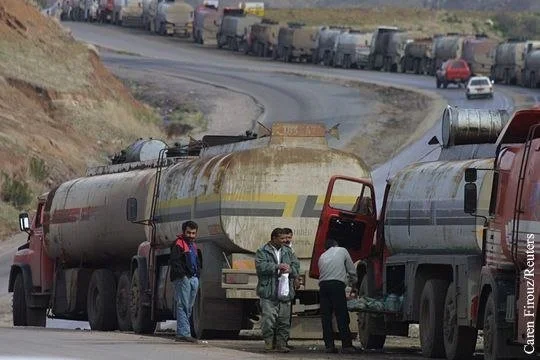
Due to blocked maritime export route, Iraq began transporting crude oil to Syria by road in March 2026. The trucks go into Syria daily via al-Waleed border crossing in Anbar. In April 2026, daily exports amounted to 500-700 trucks, which corresponds 15 kt.
Jordan
Jordan imports approximately 1.4 thousand tons per day from Iraq (as of 2024). The imports are carried out under intergovernmental agreements. Iraqi oil accounts for approximately 7% of Jordan's total oil consumption.
Export of Petroleum Products
High-sulfur straight-run fuel oil
Iraq has been the leading global supplier of this type of fuel oil since 2022. Previously, Russia was the leading supplier of this type of fuel oil worldwide.
Supply volume by year:
2021 - 20 ktd.
2022 - 27 ktd.
2023 - 41 ktd.
2024 - 50 ktd.
In 2024, 65% of the supplies were sent to neighboring countries in the Middle East. Iraq has become the third-largest supplier of high-sulfur fuel oil to the world's largest physical trade hub, Singapore Strait. Iraq is the leading supplier of high-sulfur fuel oil to Fujairah. Additionally, significant volumes are sent to Chinese cities such as Zhoushan and Hong Kong, which are also major ship bunkering centers.
According to market rumors, a significant portion of Iraqi fuel oil exports is controlled by Iranian oil companies. It is possible that Iraqi fuel oil is blended with Iranian fuel oil as a counterbalance to Western pressure on Iran.
Georgia
Iraqi companies supply bitumen to Georgia.
Impacts of Wars
Iraq faces regular attacks on its oil fields and refineries.
2024
On 16.01.2024 owner of the Falcon Group (https://falconiraq.com/about) and Empire (https://empireworld.com/) oil companies,Peshrav Dzeyi, was killed as a result of Iran's attacks on Erbil (Kurdistan, Iraq). He was Kurdish-ethnic businessman, collaborating with Israeili Mossad.
War of Isreal and USA against Iran in 2025
One of the consequences of the Israeli-US War against Iran in June 2025 was departure of employees from Western oil companies working in the country due to deteriorating security conditions. Number of specialists who left in June 2025 alone is estimated at 4860. The largest number of employees left British BP (1700), French TotalEnergies (1000), US Schlumberger (700), Italian Eni (560) and US ExxonMobil (400).
War of Isreal and USA against Iran in 2026
11.03.2026 - two tankers were attacked in a port during STS of gas condensate and/or naphtha: Safesea Vishnu (9327009), owned by a small shipping company Safe Sea (USA), and Zefiros (9515917), owned by a small private Greek shipping company. The tankers were damaged by fire and may have burned completely.
14.03.2026 - Lazan Refinery in Kurdistan was attacked and damaged. Fire spreaded across the plant. Refinery suspended operations.
17.03.2026 - drones attacked one of the world's largest fields, Majnoon, in southern Iraq. The field is owned and developed by Basra Oil Company. Production volume is 12.3 MTPA (34 ktd).
01.04.2026 - Iranian UAVs attacked oil depot of Castrol (USA) near Erbil.
04.04.2026 - Iran attacked the production facilities of oilfield service companies from the United States in southern Iraq, including the Haliburton facilities.
Notes:
Detailed data on global oil market is available in Crude Oil and Petroleum Products module of Seala AI Terminal.
Join Seala AI’s Linkedin page to be informed for all new future releases with new dashboards and insights.
Non-mainstream oil and gas news and views are available in Seala AI’s telegram channel.